






Now Available
Jiffy Knee Replacement
Innovative robotic knee replacement surgery that allows many patients to go home the same day and begin recovery with less pain and greater confidence.
About Jiffy Knee Surgery
with Dr. Drew Ratner
Jiffy Knee replacement is an advanced, minimally traumatic approach to total knee replacement designed to reduce pain and accelerate recovery. Unlike traditional techniques that often involve cutting the quadriceps tendon, the Jiffy Knee method preserves the key muscles that power the knee—helping patients return to walking, climbing stairs, and daily activities faster.
At American Orthopedics, Dr. Drew Ratner is trained and certified to perform the Jiffy Knee technique. By combining muscle-sparing surgical principles with advanced robotic-assisted technology, he offers patients a more comfortable recovery experience along with the enhanced precision associated with modern total knee replacement.
This innovative robotic Jiffy knee approach allows many patients to go home the same day and begin recovery with less pain and greater confidence—while benefiting from highly accurate implant placement designed to optimize long-term results.
"As an orthopedic surgeon, my goal is always to help patients recover faster and get back to their lives with less pain. The Jiffy Knee technique allows us to preserve the muscles that matter most—while robotic technology helps us place the joint with a level of precision that truly impacts long-term outcomes"
- Dr. Drew Ratner, MD, Board-Certified Orthopedic Surgeon
Why Patients Choose Dr. Ratner
The region’s most preferred orthopedic surgeon
Choosing the right surgeon is one of the most important decisions you’ll make when considering knee replacement.
At American Orthopedics, patients receive expert care in a personalized, high-touch environment focused on outcomes, efficiency, and patient experience.
Specialized Training in Jiffy Knee
Dr. Ratner is trained and certified in the Jiffy Knee technique, offering a modern, muscle-sparing approach to knee replacement.
Robotic-Assisted Surgical Expertise
He utilizes advanced robotic technology to enhance precision, alignment, and overall surgical outcomes.
Advanced Surgical Background
Fellowship-trained in sports medicine with extensive experience in joint replacement and minimally invasive techniques.
Continuity of Care
You’ll see Dr. Ratner at every stage—from consultation through recovery—ensuring a consistent, personalized experience.
What Is the Jiffy Knee Technique?
The Jiffy Knee technique is a specialized method of total knee replacement that focuses on minimizing trauma to the muscles and tendons surrounding the knee—especially the quadriceps tendon, which plays a critical role in walking, balance, and overall knee stability.
In traditional knee replacement, the quadriceps tendon is often cut to provide access to the joint. While effective, this creates additional trauma that must heal before full strength and mobility return. The Jiffy Knee technique takes a different approach.
Instead of cutting through this tendon, the Jiffy Knee method uses advanced instruments to gently lift and move the muscle aside. By preserving the natural structure of the quadriceps and surrounding soft tissues, patients often experience less pain, improved early mobility, and a smoother recovery process.
The goal is simple: deliver the same durable, long-term results of a knee replacement while making the recovery process significantly easier on the patient.
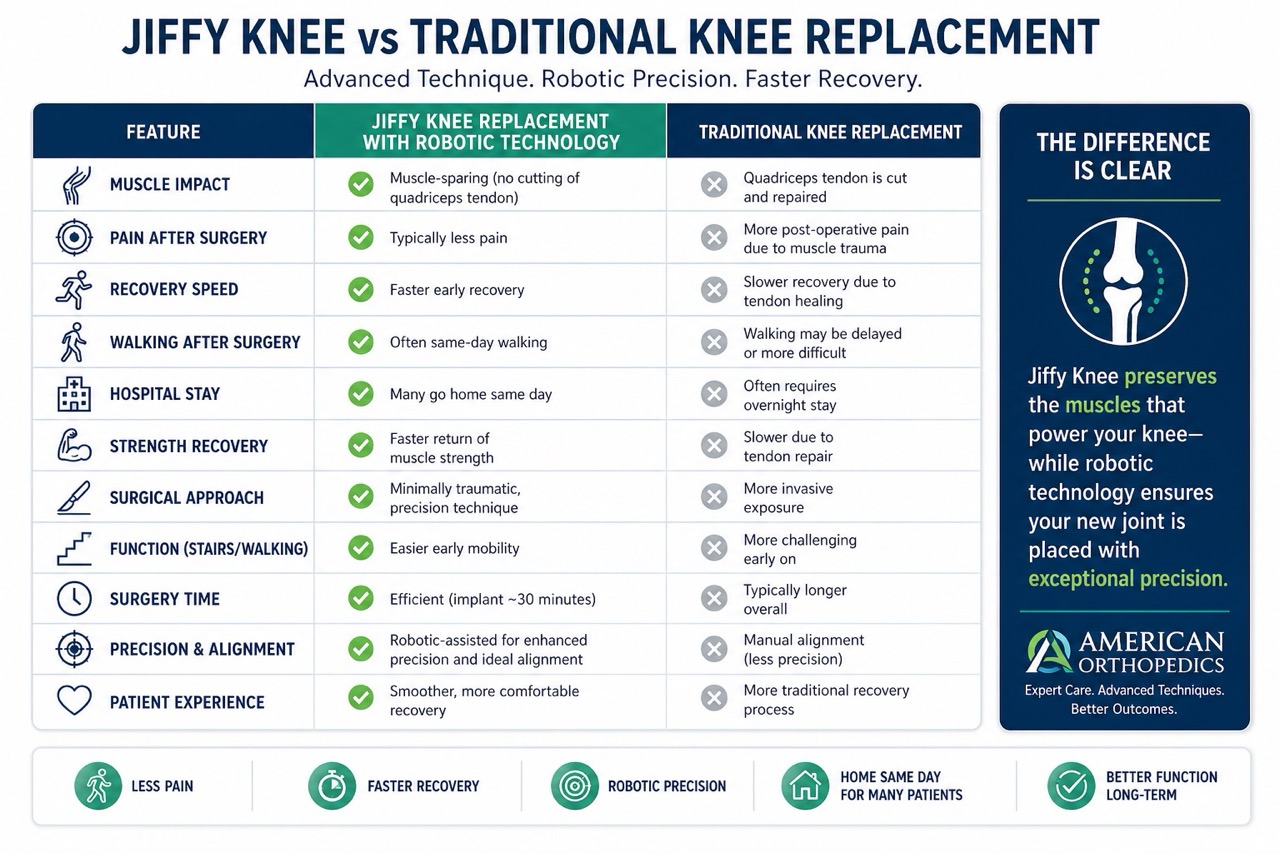
Traditional Knee Exposure vs Jiffy Knee
The difference is simple. Jiffy Knee preserves your muscles—while robotic technology ensures your new joint is placed with exceptional precision.
Traditional Knee Replacement
In many traditional knee replacement procedures, the surgeon cuts through the quadriceps tendon to gain access to the knee joint. After the implant is placed, the tendon is stitched back together.
The quadriceps tendon is one of the most important structures for walking, climbing stairs, and stabilizing the knee. Cutting it can lead to increased pain, reduced strength, and a slower recovery, as the body must heal both the joint and the tendon before full function returns.
Patients often experience more discomfort in the early stages of recovery and may require more time to regain strength and confidence in the knee.
Jiffy Knee Approach
With the Jiffy Knee technique, the quadriceps tendon and VMO muscle are not cut. Instead, the muscle is gently lifted and moved aside using specialized instruments. By avoiding unnecessary muscle damage, Jiffy Knee provides a smoother and more comfortable recovery experience—without compromising long-term results.
This approach: Preserves the muscles that power the knee, Reduces post-operative pain, Allows for faster early mobility, Helps many patients walk the same day, Often supports same-day discharge
Who Is a Candidate?
You may be a candidate for Jiffy Knee replacement if you are experiencing chronic knee pain due to arthritis or joint degeneration and have not found relief with conservative treatments.
Over time, conditions such as osteoarthritis can wear down the cartilage in the knee, leading to pain, stiffness, swelling, and decreased mobility. When these symptoms begin to interfere with daily activities, joint replacement may become the most effective solution.
Common candidates include patients who:
- Have advanced knee arthritis
- Experience pain with walking, standing, or climbing stairs
- Have limited motion or stiffness
- Have not improved with injections, medications, or physical therapy
During your consultation, Dr. Ratner will evaluate your condition, review imaging such as X-rays, and discuss your lifestyle goals. This personalized approach ensures that the treatment plan is tailored specifically to your needs and expectations.
Benefits of Jiffy Knee
Jiffy Knee offers several advantages over traditional knee replacement techniques by focusing on both surgical technique and advanced technology.
Key benefits include:
- Muscle-sparing surgical approach
- Less post-operative pain
- Faster early recovery and mobility
- Shorter surgical time
- Same-day discharge for many patients
- Quicker return to daily activities
- Enhanced precision with robotic-assisted technology
- Improved implant alignment and joint balance
- Excellent long-term joint function
By preserving the structures that drive knee movement and enhancing accuracy during implant placement, patients often feel more stable, more confident, and more comfortable earlier in the recovery process.
What to Expect with Jiffy Knee Surgery
Experience advanced care at American Orthopedics.
1. Your consultation
At your consultation, Dr. Ratner will perform a thorough evaluation of your knee, including a physical exam and a review of imaging such as X-rays.
He will take the time to understand your symptoms, activity level, and goals. From there, he will explain your diagnosis, review all treatment options, and determine whether a minimally invasive, muscle-sparing approach like Jiffy Knee is the best fit for you.
You’ll leave with a clear, personalized plan designed to restore your mobility, reduce your pain, and help you return to the activities you enjoy.
2. The Procedure
Jiffy Knee replacement is performed in a surgical center or hospital under anesthesia.
Using specialized instruments, Dr. Ratner accesses the knee joint while preserving the surrounding muscles. The damaged joint surfaces are then replaced with advanced implants designed to restore natural movement and stability.
Robotic-assisted technology is used during the procedure to guide implant positioning with a high degree of accuracy. This helps ensure that the knee is properly aligned and balanced—two key factors in long-term success.
Because the quadriceps tendon remains intact, many patients are able to stand and begin walking shortly after surgery.
3. After Surgery
Recovery with the Jiffy Knee technique is often faster and more comfortable than traditional knee replacement.
- Day of Surgery: Most patients stand and begin walking with assistance.
- Week 1–2: Pain and swelling decrease while mobility improves.
- Week 3–6: Many patients walk independently and resume daily activities.
- 10–12 Weeks: Most return to full activity with improved strength and function.
Every recovery is different, and Dr. Ratner will guide you through each phase to ensure the best possible outcome.

Advanced care for maxium results & comfort
Jiffy Knee Recovery Tips
Stay Mobile Early
Walking soon after surgery helps promote circulation, reduce stiffness, and restore movement.
Follow Weight-Bearing Guidance
Using assistive devices as recommended protects your knee during the early healing phase.
Manage Swelling
Ice, elevation, and compression can significantly reduce discomfort and improve mobility.
Commit to Physical Therapy
Consistent rehabilitation is essential for rebuilding strength, flexibility, and stability.
With consistency and support, most patients achieve excellent outcomes and return to their active lifestyle.
FAQ
Q: Is Jiffy Knee different from traditional knee replacement?
A: Yes. The key difference is that Jiffy Knee avoids cutting the quadriceps tendon, which helps reduce pain and speed up recovery.
Q: Is Jiffy Knee robotic?
A: The Jiffy Knee technique focuses on muscle preservation, and at American Orthopedics it is combined with robotic-assisted technology to enhance precision during implant placement.
Q: Is robotic knee replacement better?
Q: How long does recovery take?
Book a Jiffy Knee Consultation
If knee pain is limiting your mobility and quality of life, the Jiffy Knee technique may offer a faster, less painful path to recovery.
Call American Orthopedics today at 864-807-9998 or schedule your consultation online to learn more about Jiffy Knee replacement with Dr. Drew Ratner.